





Sleep Disorders...
“When the mind struggles to switch off, sleep can feel out of reach — but it doesn’t have to stay that way.”
Understanding Sleep Difficulties…
Sleep disorders can begin for many different reasons. Worry and anxiety are among the most common causes, but sometimes there may be underlying issues from past experiences that are contributing to the problem.
For some people, it may start with:
- A stressful period in life
- Overthinking or racing thoughts
- Changes in routine
- Emotional experiences that haven’t been fully processed
Over time, the mind can begin to associate bedtime with wakefulness, frustration, or anxiety.
Why Sleep Can Become Difficult…
Sleep is a natural process — but it relies on the mind and body being able to relax. When the mind is busy or alert, the body remains in a more active state, making it difficult to drift off.
You may notice:
- Lying awake with a busy mind
- Waking during the night and struggling to get back to sleep
- Feeling tired but unable to switch off
- Becoming frustrated or anxious about not sleeping
This can then create a cycle:
The more you try to sleep… the harder it can become.
Understanding Your Natural Sleep Rhythm…
Your body has its own natural internal clock, known as your circadian rhythm.
This rhythm helps regulate:
- When you feel awake
- When you feel tired
- Your natural sleep and wake cycle
It works alongside natural light and darkness, helping your body to wind down in the evening and wake up in the morning.
Your Natural Sleep Rhythm...
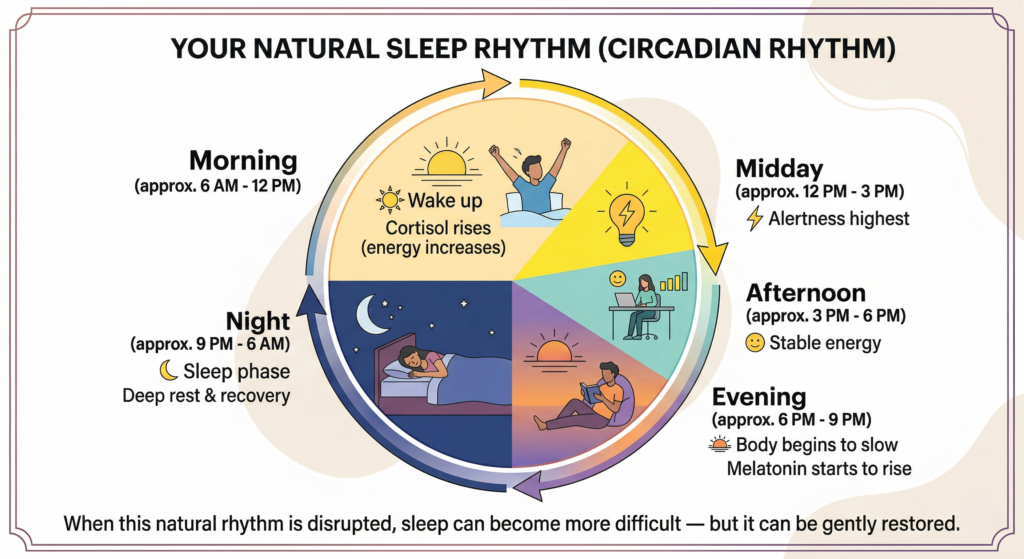
When the Rhythm Becomes Disrupted…
Why Sleep Can Become Difficult…
Sometimes this natural rhythm can become disrupted through a combination of lifestyle, emotional and environmental factors.
Stress and anxiety can keep the mind alert long after the body is ready to rest, while irregular sleep patterns or changes in routine can confuse the body’s internal clock.
In today’s world, overstimulation is also a common factor — particularly from screens such as phones, tablets and televisions. The ‘blue light’ emitted from these devices can interfere with the body’s natural production of melatonin, the hormone that helps us feel sleepy, making it harder to wind down in the evening.
Emotional experiences and life changes can also play a part, leaving the mind processing thoughts at night rather than switching off. When this happens, the body can become unsure of when it should be awake or asleep, often leading to feeling tired during the day yet wide awake at night, and unable to fully relax at bedtime.
Bringing the Body Back into Balance…
The good news is that your circadian rhythm can be gently guided back into balance.
By calming the mind and creating more positive sleep patterns, the body can begin to recognise when it’s time to rest, feel naturally tired at the right time and return to a more regular sleep cycle.
Hypnotherapy can support this process by helping the mind and body work together again — naturally and effortlessly.
“Sleep is not something the body forgets — sometimes it just needs gentle guidance to find its rhythm again.”
The Subconscious Mind & Sleep…
The subconscious mind plays a huge role in sleep patterns.
If the mind has learned to:
- Stay alert at night
- Overthink at bedtime
- Associate the bed with wakefulness
…it will continue to repeat that pattern. Even if consciously you want to sleep… the subconscious may still be running an old programme.
How Hypnotherapy Can Help…
Hypnotherapy works by accessing the subconscious mind — the part of the mind where many of our habits, patterns and responses are created and stored. When sleep has become difficult, it is often because the mind has learned to stay alert at the wrong time, even when the body is ready to rest. By working at this deeper level, hypnotherapy can help to gently calm an overactive mind, address any underlying causes, and begin to create new, more positive associations with sleep.
As the mind begins to relax and let go of old patterns, the body can naturally follow, allowing sleep to return in a more effortless and natural way. Rather than trying to force sleep, hypnotherapy helps you reconnect with your body’s own ability to rest.
Through this process, you may begin to notice:
- A quieter, calmer mind at bedtime
- Less tension or anxiety around sleep
- An increased ability to relax both mentally and physically
- A growing confidence in your ability to sleep naturally
Over time, this can support a return to a more balanced and restful sleep pattern, helping you to feel more refreshed, energised and in control.
“Many people worry they will never sleep properly again — but sleep patterns can be changed.”
Common Sleep Issues Supported…
- Insomnia
- Difficulty falling asleep
- Waking during the night
- Light or restless sleep
- Overthinking at bedtime
- Sleep anxiety
A Simple Tip for Better Sleep…
If your mind feels busy at night, try this:
As you lie in bed, gently bring your awareness to your breathing…
Slowly breathe in through your nose…
…and out through your mouth…
Then softly say to yourself:
“There is nothing I need to do right now… nowhere I need to be.”
Allow your body to soften…
and give yourself permission to rest — even if sleep doesn’t come straight away.
Find Out More…
If you are struggling with sleep and would like to find out how hypnotherapy could help, please feel free to get in touch via the Contact Form.
Michelle Townsend
Harmony Life Balance
Client Experience – Insomnia
I have suffered with insomnia for many many years. Even as a child I was reluctant to go to bed and would do anything to stay up late. I got to the point where I couldn’t function due to lack of sleep. In desperation I went to see Michelle. I was apprehensive as I didn’t know what to expect but she is so friendly and warm I soon relaxed. The experience was mind blowing. Michelle got to the root cause of my insomnia which was a revelation and from that night, about 3 months ago, I go to bed at a decent time and actually sleep. I feel so much better, happier and contended since seeing Michelle. I would highly recommend her for any difficulty. She is amazing!
— JE, Dudley (May 2019)